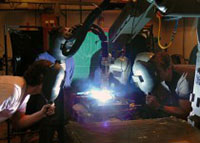
Being part of the 1st World teaching of Mechanical Engineering at UFSC since 1974!
The creation of what is currently called LABSOLDA arose as a consequence of the contact established by Professor Caspar Erick Stemmer with Professor Dr. Ing. Paul Drews from the University of Aachen. This contact was established during his trip to Germany in late 1972, aiming to establish the possibility of international support for the Mechanical Engineering Department. According to Prof. Drews, there was a possibility of obtaining support from the "Internationales Büro," an organ of the former KFA (Kernforschungsanlage) and today called Forschungszentrum Jülich (Jülich Research Center). Prof. Drews mediated the connection between Prof. Stemmer and that KFA organ. As an initial result of this connection, Prof. Stemmer was introduced to Eng. Egon Sigsmund, a welding technician at KFA, an exemplary professional who acted technically and with tireless dedication in transmitting the first training sessions on the equipment that came as a donation from the German government through the aforementioned Internationales Büro. Without a doubt, Mr. Sigsmund was a key person in what LABSOLDA is today.
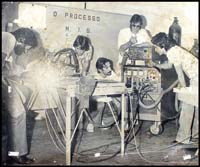
The equipment received as a donation from the German Government through the "Internationales Büro" were: a machine for the TIG and Shielded Metal Arc Welding (SMAW) process from the company Oerlikon (France), a machine for the MIG/MAG process from Cloos (Germany), a spot welding machine from ARO (France), a small machine for hydrogen flame brazing from Alexander Binzel (Germany), a small rotary table for tube welding, and various artifacts for oxy-acetylene flame (state-of-the-art equipment). This equipment arrived in late 1973.
At the time, LABSOLDA had two pieces of equipment acquired in the domestic market, consisting of an electric welding machine for shielded metal arc welding and oxy-acetylene welding equipment. The Metallurgical Technology course, which incorporated content related to welding, was taught by Prof. Almir Monteiro Quites.
The hiring of Eng. Jair Carlos Dutra in March 1974, together with the arrival of the modern equipment from Germany mentioned above, alongside Prof. Quites and the participation of Eng. Sigsmund through frequent trips to Brazil, created an important laboratory for the training of students, future mechanical engineers, but also for supporting the industrial sector in solving its problems in the welding area.
There were many difficulties in keeping the equipment from Germany functioning properly, as the university's infrastructure was not prepared to support the laboratory's needs. Eng. Sigismund also provided assistance in the acquisition of samples, spare parts, and consumables, thus supplying the needs of the laboratory.
LABSOLDA was created, today a reference institution in Brazil.
Below are listed some prominent milestones throughout the years of LABSOLDA's existence:
- The first master's dissertation in Brazil in Welding Technology, presented by Prof. Jair Carlos Dutra in 1976.
- Organization of the II Latin American Congress of Welding Technology, and the publication of the book Voltaic Arc Welding Technology in 1979 by professors Quites and Dutra.
- Subsequently, a highly relevant milestone was the support of the National Nuclear Energy Commission (CNEN) for conducting specialization courses in welding engineering in 1981, 1982, and 1983.
- The CNEN also supported the development of the first prototypes of welding power sources in 1981, in a multidisciplinary work between LABSOLDA and the Electrical Engineering Department.
- The Sandwich Doctorate of Prof. Jair Dutra, completed in 1989, with an internship period at the APS Automation Institute of the RWTH Aachen Technical University, was decisive in establishing the foundations of the Research, Development, and Innovation lines adopted by LABSOLDA.
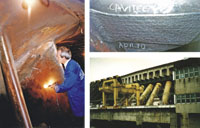
- In the evolution of LABSOLDA, one cannot omit the development, for the company TRACTEBEL-Energia (then GERASUL), of the unprecedented technology for the welding recovery of eroded parts of its hydraulic turbines, a work that later culminated in the granting of the first patent letter to UFSC.
- As a byproduct of the convergence of these cooperations and strategies, two companies emerged: IMC-Soldagem in 1992, a manufacturer of power sources, and SPS-Soldagem in 2001, in the production of welding automation systems.
- 2007: First patent of LABSOLDA and UFSC - In partnership with the then Mechanical Engineering Junior Enterprise, LABSOLDA obtains the first patent letter granted to UFSC, entitled: Pulsed MIG/MAG welding process with thermal or double pulsation.
- 2009: International Cooperation - With the technical visit to the ISF – Institut für Schweißtechnik und Fügetechnik of the Technical University of Aachen, Germany, within the scope of Prof. Régis Silva's Doctorate, the exchange program with this institute begins, which has provided international experience to several members of LABSOLDA. Subsequently, other institutes and companies from that country joined LABSOLDA's exchange program with German institutions, coordinated by the same professor.
- 2010: High-Speed Videography - LABSOLDA inaugurates the exploration of high-speed filming, not only as an R&D tool but also as an object of development, as an initiative of Prof. Régis Silva's postdoctoral work. This culminated in a leap in investigations into the physics of welding and in positioning the results obtained at an international reference level.
- 2015: Régis Silva assumes the coordination of LABSOLDA - "Professor Régis Henrique Gonçalves e Silva assumes the coordination of LABSOLDA, starting a new cycle of intense internationalization. During this period, the laboratory expanded academic exchange with foreign institutions and consolidated strategic partnerships with large Brazilian and international companies, strengthening the research, development, and innovation (R&D+I) ecosystem."
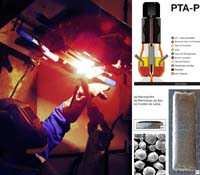
- 2017: Wire Arc Additive Manufacturing - "LABSOLDA establishes itself in Industry 4.0 (Advanced Manufacturing), with the beginning of the R,D&I Line in Additive Manufacturing."
- 2017: Second LABSOLDA patent - The second patent letter is granted, referring to the invention: Pen-type Automatic Feeding Device for Application in Operations Involving Wire Material Addition.
- 2018: Laser Welding - LABSOLDA inaugurates the Laser Welding research line with its own equipment and infrastructure for activities and R&D. The first work was Thaffarel dos Santos' master's dissertation entitled Implementation of a CO2 Laser System for Welding Applications. The research line would later be reinforced by the incorporation of manual laser welding technology in 2025.
- 2020: Third LABSOLDA patent - The third patent letter is granted, referring to the invention: CONTROLLED SHORT-CIRCUIT WELDING PROCESS. The development began with Prof. Régis Silva's master's dissertation, entitled MIG/MAG Welding in Controlled Short-Circuit Metal Transfer Applied to the Root Pass.
- 2024: This year we celebrate the 50th jubilee of LABSOLDA - "Throughout this history, we have the satisfaction of being able to contribute to the consolidation of EMC [Mechanical Engineering Department] and the enrichment of UFSC in general in its 3 pillars of Teaching, Research, and Outreach. Our laboratory is a hub of professionals with distinguished knowledge in Welding Science and Technology, present in reference institutions and companies in Brazil and abroad. This performance has brought awards to UFSC, such as the Stemmer FAPESC Awards, FINEP Award, UNESCO - Mercosur Award, PETROBRAS Awards (Inventor and Pipeline Technology), as well as specific awards in events of ABCM, PETROBRAS, the Brazilian Welding Association, and SENAI. This history of success is due to people, to our team of collaborators, with their effort, dedication, boldness, curiosity, and 'passion for the cause', with the resilience and perseverance necessary to overcome barriers and challenges."
- 2025: Institutional formalization of the updated name - LABSOLDA - Welding and Mechatronics Institute